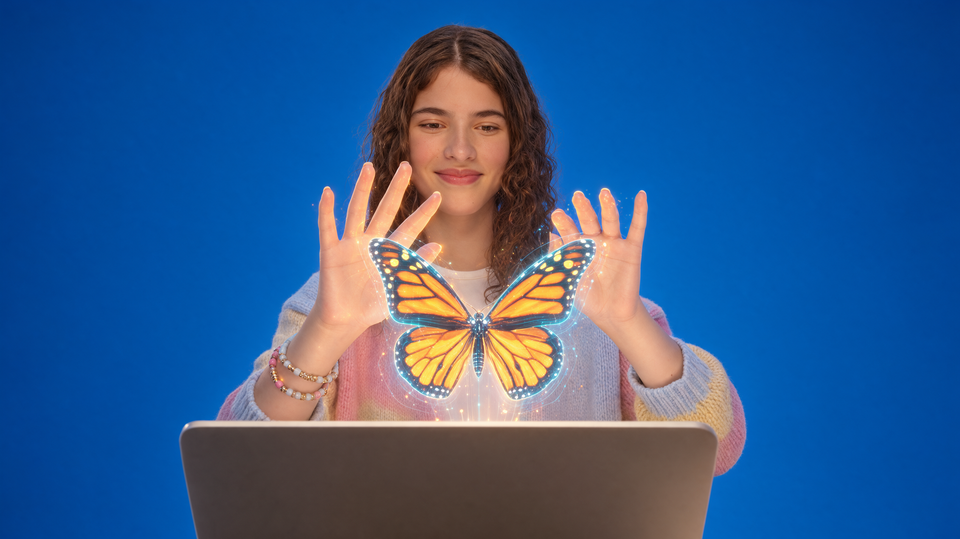
Interactive 3D Science Simulations: Bringing Science to Life in the Classroom
With Merge 3D, teachers can bring interactive models and simulations into everyday science lessons, helping students move beyond simply seeing or reading about a concept to actively exploring it.

Science is full of ideas that are difficult to understand by reading about them alone. Students learn about the movement of planets, the structure of cells, the forces that shape our world, and the invisible processes that keep living things alive. But when these concepts are confined to a textbook or a flat image, it can be challenging for students to visualize how they actually work.
Interactive 3D science simulations give students another way to explore these ideas. Instead of simply looking at a diagram, students can examine a model from different angles, interact with its features, and develop a more complete understanding of the concepts behind it. With Merge 3D, students can explore science through interactive digital objects and simulations that bring abstract concepts into a tangible learning experience.
Making Abstract Science Concepts Easier to Understand
Many science topics involve structures, processes, or systems that students cannot easily observe in the real world. A student studying the human heart might understand its basic function from a textbook, but exploring a detailed 3D model can help them visualize its chambers, examine its structure, and better understand how its parts work together. The same approach can help students explore the solar system, investigate the structure of an atom, or examine the layers of Earth.
Interactive models also give students the opportunity to approach a concept from multiple perspectives. They can rotate an object, zoom in on specific features, and explore relationships that might otherwise be difficult to see. This kind of exploration encourages students to ask questions, investigate details, and connect what they observe to what they are learning in class.
Turning Science Lessons Into Active Exploration
One of the advantages of interactive 3D science simulations is that they give students a more active role in the learning process. Rather than passively receiving information, students can investigate a model and make observations of their own. That exploration can become the starting point for classroom discussions, written explanations, group activities, and scientific inquiry.
For example, a lesson about the human body could begin with students exploring a 3D model of an organ system. Students might identify its major structures, examine how different parts connect, and explain what they notice. A lesson about astronomy could invite students to explore celestial objects and compare their characteristics. In each case, the digital model provides a shared visual reference that students and teachers can use to discuss scientific ideas.
These experiences can also support different learning needs. Students who benefit from visual or spatial learning opportunities can explore a concept in a way that complements reading, instruction, and traditional classroom activities. Teachers can use the same model to introduce a topic, reinforce a lesson, or help students revisit a concept they are still working to understand.
Connecting 3D Science Simulations to Hands-On Learning
Interactive 3D simulations do not have to replace physical science activities. They can work alongside classroom experiments, demonstrations, and lab investigations to give students additional ways to understand what they are observing.
A student might use a physical model during one part of a lesson and explore a digital version during another. A class studying geology could examine real rocks and minerals before exploring digital models that reveal their structures or provide additional context. Students learning about anatomy could combine classroom instruction with interactive models that help them visualize structures that are difficult to observe directly.
Merge 3D makes this kind of exploration accessible through a web-based learning and creation platform. Students can explore interactive 3D objects and science simulations, with options for viewing models on screen, placing them into the real world through augmented reality, or using the Merge Cube for a more hands-on experience.
Bringing Interactive 3D Science Into Your Classroom
Science instruction is most powerful when students have opportunities to explore, question, and make connections. Interactive 3D simulations can help teachers create those opportunities by giving students a new way to investigate scientific concepts and visualize the systems and structures they are learning about.
Explore Merge 3D and discover new ways to bring science to life in your classroom at trymerge.com.